How can we use scientific notation?
How to write in scientific notation
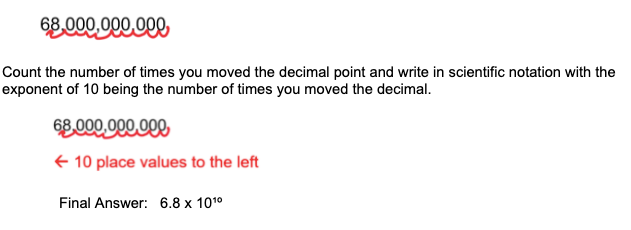
Let’s start by explaining how to write numbers in scientific notation. When you are given a very large number, you will move the decimal point so that the number is greater than or equal to 1 and less than 10. Since we are shifting the decimal point to the left or the right, we need to make sure that the number has the same value as the original number. See the example below:
125,000,000 ← The decimal is currently after the last 0, the ones digit
12,500,000.0 x 10 ← This number is equivalent, as we move the decimal in we multiply it by 10 1,250,000.00 x 10² ← Since we moved it twice, we must multiply it by 10 twice, or 10²
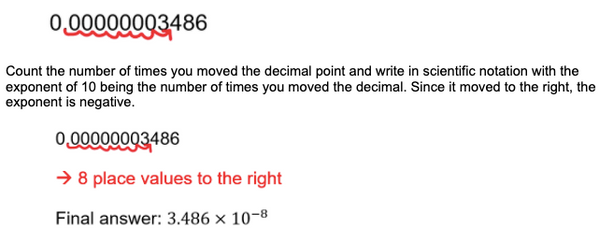
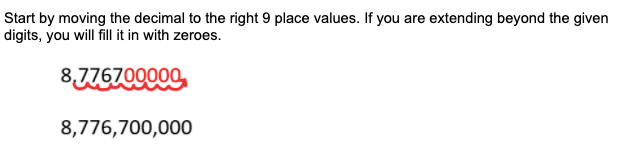
We continue this process until the decimal point moves between the 1 and the 2, creating 1.25 (a number greater than or equal to 1 and less than 10). However many times you move the decimal point will be the exponent of 10. If you are moving the decimal to the left, then the exponent is positive, such as the above example. If you are moving the decimal to the right, then the decimal is negative since we are essentially dividing by 10.
How to add/subtract in scientific notation
Numbers with exponents can be added or subtracted only if they have the same base and exponents. Numbers in scientific notation already have the same base of 10, so it is important that the exponents match. We need to manipulate the numbers so that the base of 10 has the same exponents, meaning the digits have the same place value when we combine by adding or subtracting the coefficients.
Steps:
- Determine the number by which to increase the smaller exponent to make it equivalent to the large exponent.
- Increase the smaller exponent by this number and move the decimal point to the left (you are dividing by the appropriate power of 10 here)
- Add or subtract the new coefficients
- If the final answer is not in scientific notation, convert it to scientific notation
How to multiply/divide in scientific notation
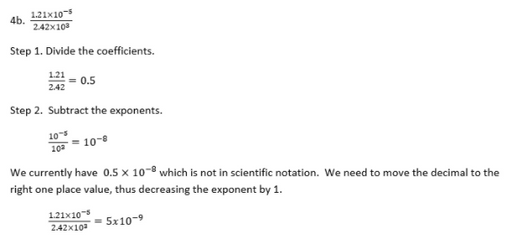
Multiplying or dividing two numbers with the same base is the same as multiplying their coefficients and adding their exponents, or dividing their coefficients and subtracting their exponents. It is not necessary for the exponents to match for us to perform these operations.
Steps for Multiplying:
- Multiply the coefficients
- Add the exponents of the base 10
- Convert the result to scientific notation if necessary
Steps for Dividing:
- Divide the coefficients
- Subtract the exponents of the base 10
- Convert the result to scientific notation if necessary